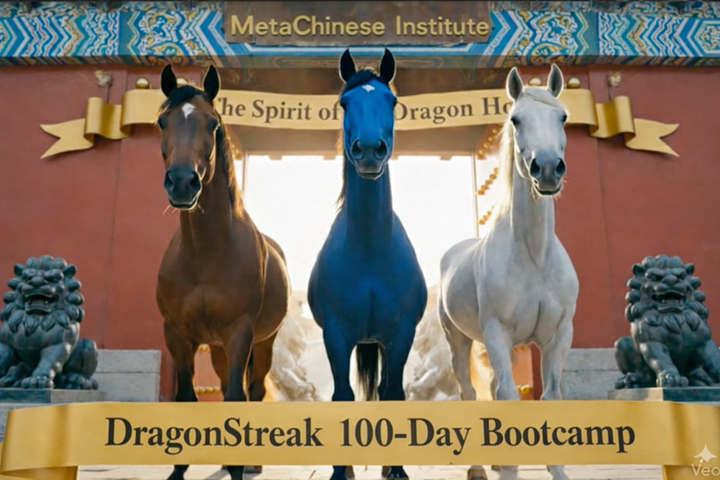
Chinese New Year 2026 — Year of the Horse
Why do both East and West celebrate in the coldest, most lifeless season of the year? What if the answer is encoded in a single Chinese character—年? Using the Beacon–Anchor Breakdown, learn to spot the beacons, anchor the meaning, and turn random squiggles into lasting memory—learn 1, know 10.
Seeing 年(nián): From Knot Tying, to Harvest, to Renewal
It’s that time of year again. As the lunar calendar turns, we welcome Chinese New Year — 2026, the Year of the Horse🐎.
The sun shifts toward the other hemisphere, and we enter the quiet season—days grow shorter, nights stretch longer. Snow settles over the frozen earth. Trees stand bare against the winter sky. Icicles glimmer softly beneath the streetlights.
And yet, in this stillness, something awakens.
Across both East and West, people choose to celebrate in the starkest winter season—from Western Christmas to the Eastern Lunar New Year. It is no coincidence that, across thousands of years of human civilization, in the coldest and most lifeless stretch of the year, we bring forth light, warmth, reunion, and renewal.
Long before written language, people recorded time with knots tied in cords. Archaeological evidence shows that early civilizations—from prehistoric China to the Inca of Peru—used knot-recording to mark numbers, events, and cycles of life.
From this ancient practice, the Chinese character 冬 (winter) echoes the idea of tying off a year’s record—securing the final knot at both ends to close a cycle. The related character 终, with the thread radical 纟, carries the meaning “to end,” “to complete.” And from completion comes renewal.
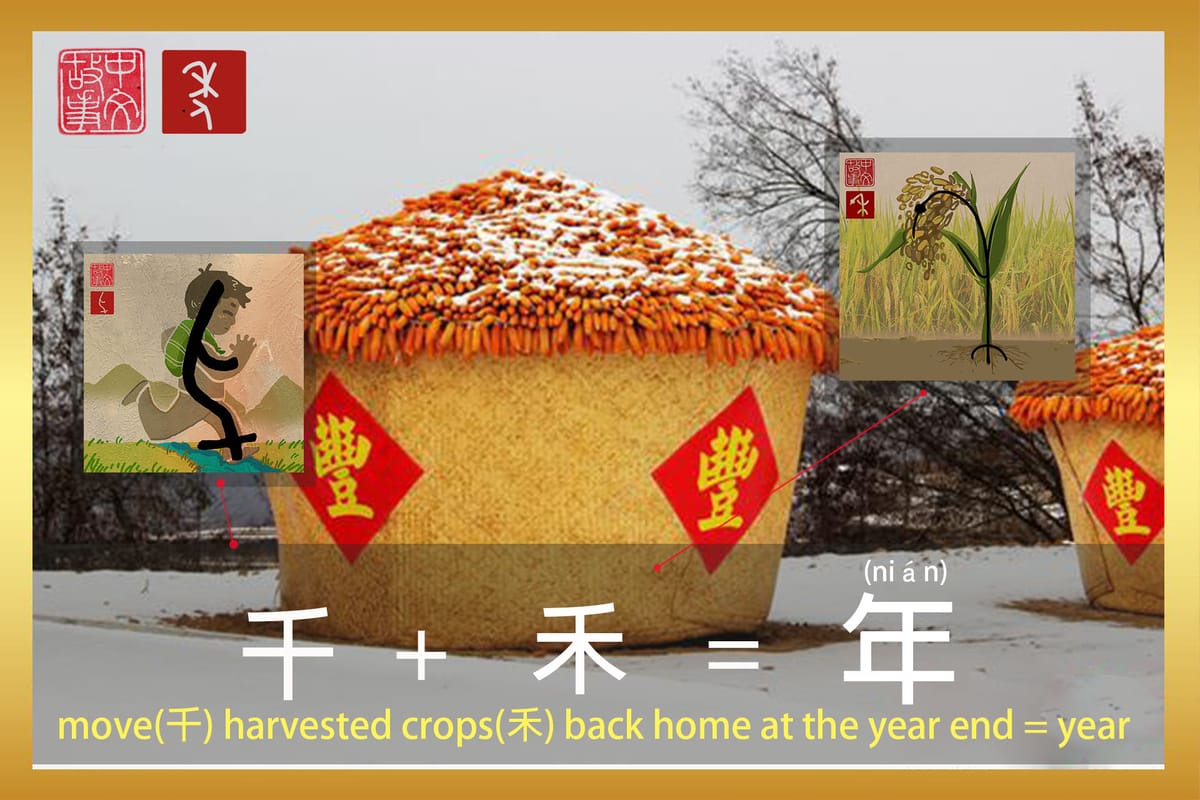
The character 年 (year) traces back to the imagery of 禾 (grain) carried home in abundance—marking the culmination of a full agricultural cycle, and the moment when effort turns into harvest.
From spring’s sowing… to summer’s growth… to autumn’s harvest— winter is the season of storing, reflecting, and honoring what the year has yielded.
This is the quiet threshold between what has been… and what is about to begin.
To mark this moment, I’ve created one single visual piece for 年—presented with modern visual aesthetics alongside clear English meaning—so that ancient structure and contemporary understanding meet on the same page.
Because learning a language is not memorizing symbols. It is entering a system of meaning.
With these two key characters, you can now practice the following phrases and sentences—notice how their meanings compound and reinforce one another.
1.冬 (dōng, winter) 天 (tiān, day) = winter
2.年 (nián, year) 终 (zhōng, end) = year end
3 . 冬天是一年的年终 (dōng tiān shì yì nián de nián zhōng)
👉 “Winter is the end of the year.”
4. 一年之终,在冬 ( yì nián zhī zhōng zài dōng )
👉 “The end of the year lies in winter.”
5. 冬天是年终之时 (dōng tiān shì nián zhōng zhī shí)
👉 “Winter is the time of the year’s end.”
Year of the Horse🐎 is about momentum, endurance, and forward motion.
So if this new year, you’re ready to stop drifting… and start building real, structured progress in Chinese—
66% less time in L2 Chinese acquisition. 3× faster to reach HSK / AP goals through structured self-study and 1:1 coaching.
A focused, guided, high-signal learning experience designed to help you:
- build structural literacy in Chinese characters
- break free from rote memorization
- and create consistent daily momentum
Let this be the year you don’t just start. You build. You continue. You deliver.
🐎 Year of the Horse. Let’s move.
Your streak begins the moment you choose “signal” over “noise”.